Today we ( I ) set up the group blog for our blog. Firstly, we thought of calling our group blog "The Chris, Ed, Jon and Jack Blog" but upon seeing another group using the name "The Fellowship" We made a group decision to one up them and go with "The Rebel Alliance" which is a much more superior group name.
The other members of The Rebel Alliance tried to assist with my task, realistically, it can only be done on one computer, so I did all the work.
Friday, 21 October 2011

Sunday, 16 October 2011
Thriller Sub-genres
As thriller is such a broad genre, for classification, it is divided into many more specific sub genres, such as:
Conspiracy Thriller
In which the protagonist faces a powerful group of enemies and is typically the only character, or one of very few characters aware of the threat and therefore participating in the conflict.
Crime Thriller
A hybrid of crime and thriller genres that are typically a suspenseful recount of a crime. They typically focus more on the criminal as opposed to the law enforcement and concentrate on action instead of psychological aspects.
Legal Thriller
In which the protagonist, typically a lawyer or attorney has a conflict with antagonists both inside the courtroom and outside. Also, there is frequently a danger to the protagonists lives that separates it from similar genres such as courtroom dramas.
Political Thriller
A thriller in which the conflict falls around a political power struggle. Typically involve giving illegal political power to an antagonist or criminal. Almost always involve national or international politics.
Psychological Thriller
A thriller in which the key conflict is psychological or emotional rather than physical. The protagonist normally stumbles into the conflict by accident and does not start out as one of the main sides to the conflict. Characters normally use more mental means to overcome their enemies, if the enemies are not themselves, as is common in some psychological thrillers.
Supernatural Thriller
In which the conflict typically involves supernatural or paranormal aspects, sometimes as part of the characters' abilities or as part of the setting around them.
 |
| Edge of Darkness |
In which the protagonist faces a powerful group of enemies and is typically the only character, or one of very few characters aware of the threat and therefore participating in the conflict.
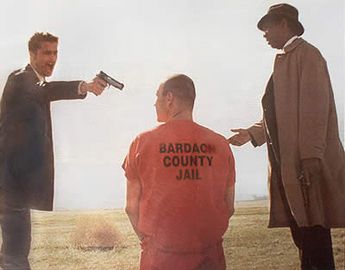 |
| Seven |
Crime Thriller
A hybrid of crime and thriller genres that are typically a suspenseful recount of a crime. They typically focus more on the criminal as opposed to the law enforcement and concentrate on action instead of psychological aspects.
Legal Thriller
 |
| Law Abiding Citizen |
 |
| The Ghost |
A thriller in which the conflict falls around a political power struggle. Typically involve giving illegal political power to an antagonist or criminal. Almost always involve national or international politics.
 |
| Fight Club |
A thriller in which the key conflict is psychological or emotional rather than physical. The protagonist normally stumbles into the conflict by accident and does not start out as one of the main sides to the conflict. Characters normally use more mental means to overcome their enemies, if the enemies are not themselves, as is common in some psychological thrillers.
 |
| Unbreakable |
In which the conflict typically involves supernatural or paranormal aspects, sometimes as part of the characters' abilities or as part of the setting around them.
Thursday, 13 October 2011
Editing Techniques
Match on Action
A match on action is an editing technique which shows an action being completed over multiple shots, typically with the action in the first shot, and the result of the action in the second shot.
An example occurs in this clip of Kill Bill at 1.25 through three shots.
Shot - Reverse Shot
A shot reverse shot is a technique which typically shows a conversation, cutting back and forth between two shots, one of each character, that stays within the 180 degree rule. As the characters are facing in opposite directions in the shots from their perspective, it is assumed by the audience that they are having a conversation
An example of this in Inglourious Basterds starts with the conversation at 0.29.
180 Degree Rule
The 180 degree rule is a rule used for continuity editing that places an imaginary line passing through two characters. The camera is only allowed to stay on that side of the line and crossing the line would be disorientating to the audience. It means that both of the characters stay on one side of the shot, while crossing the line would mean they switch sides.
An example of following the 180 degree rule is in this scene from Death Proof.
Friday, 7 October 2011
Psycho Commentary Reflection
To make our film clip commentary, we first found and watched a clip from our chosen film, Psycho. As we watched it, we made notes on what we saw, particularly on the thriller conventions that we saw, such as the shadow motif. After we had rewatched the clip enough times and made sufficient notes, we added to the notes, making them into full paragraphs. We then downloaded the clip from Youtube, and adding it to iMovie so we could add a commentary. After this, we split the notes into three, and we each read our third by reading and recording a paragraph at a time, and then positioning them to fit better to the content and timings of the clip. However, we did have some difficulty with this as most of what we had to say all occurred very quickly, so we had to reposition some audio to allow the whole commentary to fit. We then uploaded the clip to Blogspot.
Through this exercise, i have acquired a better understanding of how film commentaries and voiceovers work, and how even very short clips can have very large amounts of cinematographical details to analyse. I also learnt how difficult it can be to get a commentary to match up to what is happening on screen. I also noticed how subtle some elements of the cinematography can be in a clip, and how they can only be noticed through repeated viewings or paying attention to very specific details, such as how Lila hits the light as she screams and creates the dynamic lighting found in the rest of the scene, and how subtle some of the motifs can be, so a casual watcher might not consciously be aware of them.
Through this exercise, i have acquired a better understanding of how film commentaries and voiceovers work, and how even very short clips can have very large amounts of cinematographical details to analyse. I also learnt how difficult it can be to get a commentary to match up to what is happening on screen. I also noticed how subtle some elements of the cinematography can be in a clip, and how they can only be noticed through repeated viewings or paying attention to very specific details, such as how Lila hits the light as she screams and creates the dynamic lighting found in the rest of the scene, and how subtle some of the motifs can be, so a casual watcher might not consciously be aware of them.
Subscribe to:
Comments (Atom)